
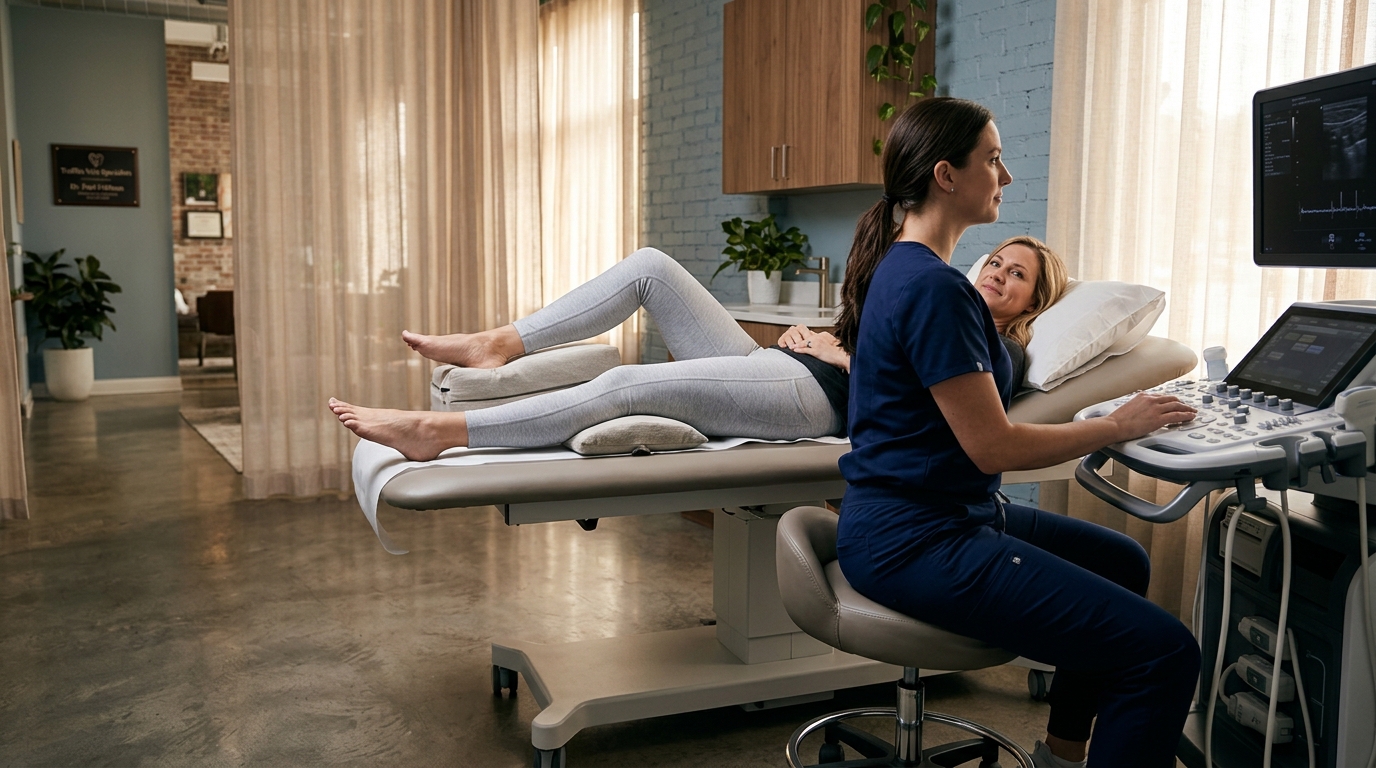
At Truffles Vein Specialists, precise patient positioning is the foundation of an accurate venous reflux ultrasound. The correct posture ensures that gravity and muscle tension are standardized, allowing our clinicians to measure blood flow reliably. This listicle details the seven specific positions used to evaluate the venous system in the legs and pelvis.
1. Standing Position
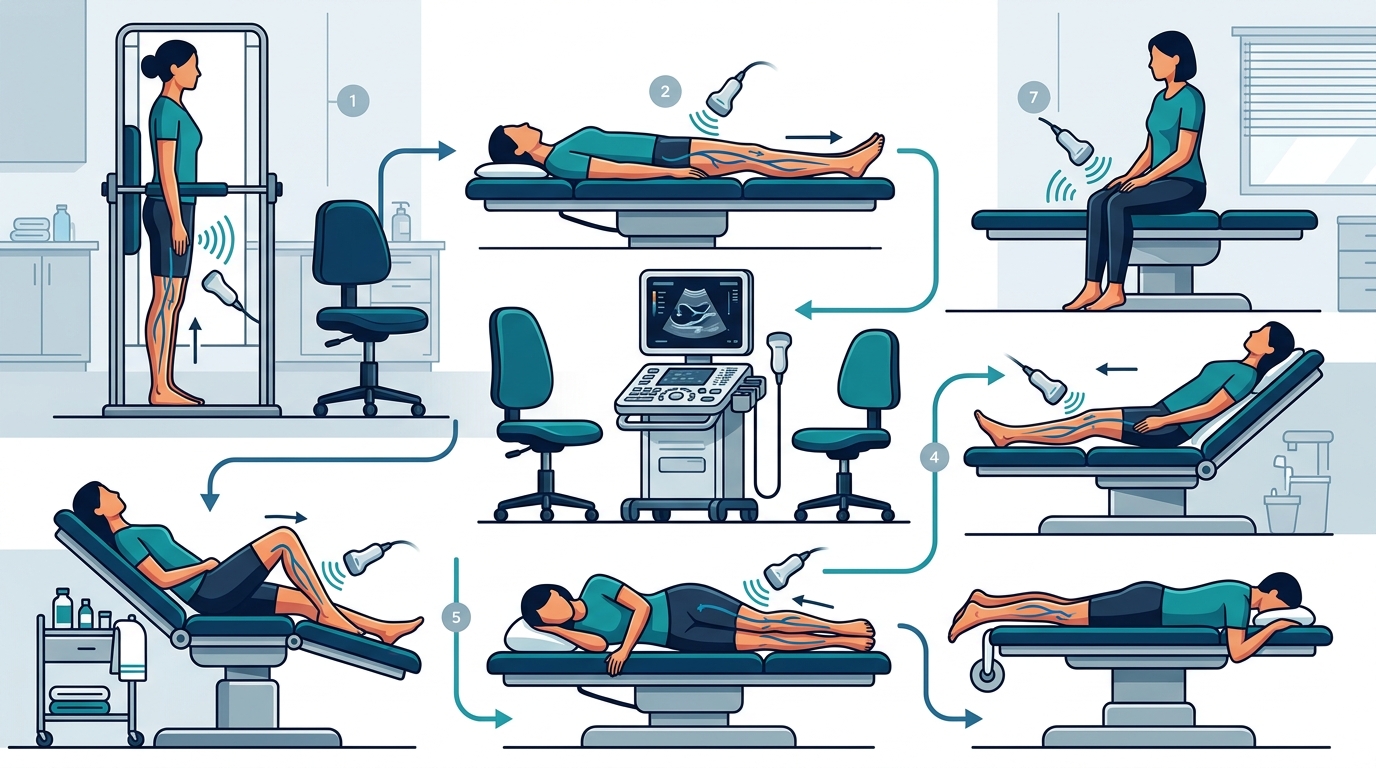
The standing position is the gold standard for evaluating superficial venous reflux. In this posture, gravity exerts maximum pressure on the venous valves, making it the most sensitive method for detecting incompetence. Our clinicians typically ask patients to stand still for a brief period before applying the ultrasound probe. This ensures that any reflux is a true physiological response rather than a transient artifact. For additional details, review the Frequently Asked Questions.
2. Supine Position
The supine position is used to assess deep venous reflux and baseline anatomy. Lying flat on the back reduces the hydrostatic pressure within the veins, which helps in visualizing the vein walls and valves without the confounding factor of gravity. This position is essential for mapping the anatomical course of the great saphenous and femoral veins. It allows for a clear comparison between the standing and lying states to determine the severity of valve failure.
3. Prone Position
The prone position is critical for evaluating the posterior venous system, particularly the small saphenous vein. Lying face down allows the ultrasound probe to access the back of the calf and the popliteal fossa without compression from the body's weight. This position is often used to assess the posterior tibial vein and the peroneal vein. It provides a different hemodynamic profile that can reveal reflux patterns not visible in other postures.
4. Reverse Trendelenburg Position
The reverse Trendelenburg position involves tilting the table to place the head lower than the feet. This specific angle, often around 60 degrees, is used to challenge the venous valves under increased hydrostatic pressure. It is particularly useful for detecting subtle reflux in the deep venous system that might be missed in a standard standing position. By increasing the pressure gradient, this position helps in staging the severity of chronic venous insufficiency.
5. Valsalva Maneuver (Seated or Standing)
The Valsalva maneuver is a functional test performed while the patient is seated or standing. The patient is asked to bear down as if having a bowel movement, which increases intrathoracic pressure. This action temporarily increases pressure in the central veins, forcing blood to flow backward if the valves are incompetent. It is a dynamic test that complements the static positional assessments by simulating real-world physiological stress.
6. Lateral Decubitus Position
The lateral decubitus position involves lying on the side to isolate specific venous segments. This position is often used to evaluate the lateral aspect of the leg or to reduce the overlap of anatomical structures. It can be helpful in assessing the lateral saphenous vein or in patients who have difficulty standing for extended periods. By changing the orientation of the body, the sonographer can optimize the acoustic window for difficult anatomical areas.
7. Upright Seated Position
The upright seated position is a transitional posture used for initial screening and patient comfort. While not as rigorous as the standing position, it allows for a preliminary assessment of the proximal veins. It is often used to acclimate the patient to the procedure and to perform initial Doppler measurements. This position is less stressful for patients with balance issues or orthopedic limitations, making it a practical starting point for the examination.
Choosing the Right Position for Your Exam
The selection of these positions is not arbitrary; it is a systematic process designed to cover all aspects of the venous system. At Truffles Vein Specialists, our clinicians tailor the sequence of positions based on your specific symptoms and anatomical findings. If you are experiencing leg swelling or varicose veins, understanding these positions can help you feel more prepared for your appointment. To schedule your venous reflux ultrasound, today. according to LCD Peripheral Venous
Frequently Asked Questions
Why is the standing position so important for venous reflux testing?
The standing position is crucial because it maximizes the effect of gravity on the veins. This increased pressure challenges the venous valves, making it the most sensitive method for detecting reflux. Without this position, subtle valve incompetence might be missed.
Do I need to be in all seven positions during one exam?
Not necessarily. The specific positions used depend on the clinical question and the patient's comfort. However, a comprehensive evaluation typically includes standing, supine, and prone positions to cover both superficial and deep venous systems.
What is the difference between supine and prone positioning in this context?
Supine positioning involves lying on the back, which is best for assessing the front of the leg and the femoral vein. Prone positioning involves lying on the stomach, which is essential for evaluating the back of the leg, particularly the small saphenous vein and popliteal vein.
Is the Valsalva maneuver painful?
No, the Valsalva maneuver is not painful. It simply requires you to bear down gently, similar to the effort used during a bowel movement. It is a standard part of the functional assessment of venous valves.
How long does the entire positioning process take?
The entire ultrasound exam, including all necessary position changes, typically takes between 30 to 45 minutes. The time spent in each position varies, but the standing and supine positions are usually the most time-consuming due to the detailed mapping required.
Can I wear compression stockings during the exam?
No, you should not wear compression stockings during the ultrasound. The stockings can compress the veins and alter the blood flow, leading to inaccurate results. You will be asked to remove them before the exam begins.