

What is the difference between sclerotherapy and laser vein ablation?
Approximately forty five million adults in the United States experience visible vein conditions that impact daily comfort and long term vascular health. Vein prevalence data confirms that these conditions rarely resolve without targeted intervention. Patients frequently request clarity on which treatment pathway delivers superior outcomes for their specific vascular anatomy. Understanding the mechanical differences between chemical injection and thermal energy delivery remains essential for making an informed clinical decision. This guide breaks down the procedural mechanics, recovery expectations, and clinical applications to help you select the optimal treatment strategy.
Understanding the Core Mechanisms
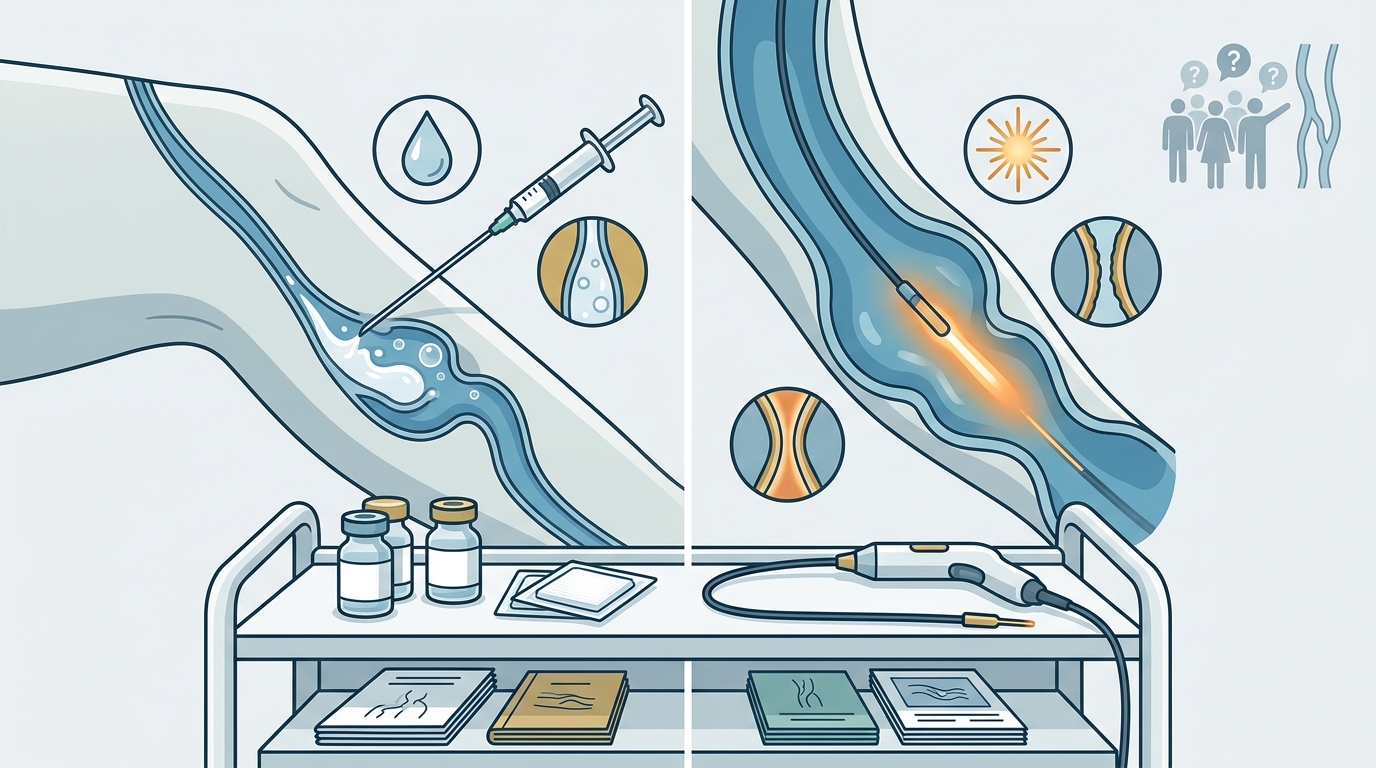
Sclerotherapy is a minimally invasive procedure that injects a chemical solution directly into targeted veins to collapse and seal them. The injected solution creates controlled irritation along the vessel wall. This irritation triggers a natural inflammatory response that causes the vein to fibrose and eventually dissolve. The body naturally reroutes blood flow to healthier surrounding vessels. Laser vein ablation is a thermal treatment method that uses concentrated light energy to heat and destroy problematic superficial vessels. The laser fiber delivers precise thermal energy to the vessel interior. This heat causes immediate protein denaturation and structural collapse of the targeted vein. Venous reflux is a condition where damaged valves allow blood to pool in the lower extremities instead of flowing toward the heart. Both treatments address this underlying mechanical failure through entirely different biological pathways. Your vascular specialist at Truffles Vein Specialists will evaluate your reflux patterns using advanced venous duplex imaging to determine which mechanism aligns with your anatomical needs.
Procedural Differences and Patient Comfort
The sclerotherapy procedure requires a physician to inject a specialized liquid or foam formulation directly into the affected vessel. The injection process typically takes ten to twenty minutes depending on the treatment area size. Patients report minimal discomfort comparable to a standard needle stick. The physician may use compression bandages immediately after the injection to support the healing process. Laser vein ablation requires a specialized fiber optic catheter to be inserted into the target vessel under ultrasound guidance. The physician activates the laser device to deliver controlled thermal energy along the entire length of the problematic vein. This process usually requires fifteen to thirty minutes per treatment zone. Local anesthesia or tumescent anesthesia numbs the surrounding tissue to ensure patient comfort during the thermal application. Both procedures are performed in our outpatient clinic environment without requiring general anesthesia or hospital admission. You can review our complete treatment protocols by visiting our vein treatments page to learn more about our clinical standards.
Target Vein Sizes and Clinical Applications
Sclerotherapy remains the gold standard for treating small to medium sized spider veins and fine reticular vessels. The chemical solution penetrates the vessel wall effectively when the target diameter measures less than three millimeters. Physicians frequently utilize foam formulations to treat larger varicose veins that require greater surface area contact. Laser vein ablation excels when treating larger diameter varicose veins that extend deeper into the subcutaneous tissue. The thermal energy penetrates deeper into the vessel structure to ensure complete closure of larger diameter vessels. Our clinical team at Truffles Vein Specialists routinely combines both modalities to achieve comprehensive aesthetic and functional results. We utilize ultrasound guided sclerotherapy for complex venous networks that require precise mapping. Visible sclerotherapy addresses superficial cosmetic concerns that do not require deep thermal intervention. Radio frequency closure and VenaSeal adhesive techniques provide additional options for patients with specific anatomical constraints. You can schedule a complimentary assessment to determine your exact vascular classification by visiting our free vein screening page.
Recovery Timelines and Post-Procedure Care
Recovery protocols differ significantly between the two treatment modalities. Sclerotherapy patients typically resume normal daily activities within twenty four hours. Mild bruising and temporary pigmentation changes may occur along the injection sites. Physicians recommend wearing compression stockings for three to seven days to support vessel closure. Laser vein ablation requires a slightly longer initial recovery window of two to three days. Patients experience localized tenderness and temporary skin sensitivity along the treatment path. Compression garments remain mandatory for two weeks to prevent blood pooling and support tissue remodeling. Both procedures require patients to avoid strenuous exercise and prolonged standing during the initial healing phase. Our clinical team provides detailed post procedure instructions to ensure optimal vascular remodeling. You can read additional patient education resources on our blog section to prepare for your upcoming consultation.
Long-Term Efficacy and Maintenance Requirements
Both treatment modalities deliver high success rates when performed by experienced vascular specialists. Sclerotherapy achieves complete vessel clearance in approximately eighty five percent of treated cases. The chemical solution effectively eliminates targeted vessels without damaging surrounding healthy tissue. Laser vein ablation demonstrates closure rates exceeding ninety percent for larger diameter vessels. The thermal energy ensures complete vessel wall fusion to prevent blood recirculation. Neither treatment prevents the development of new veins over time. Genetic predisposition and hormonal fluctuations continue to influence vascular health regardless of prior interventions. Patients typically require maintenance sessions every two to three years to address new cosmetic concerns. Our board certified physicians at Truffles Vein Specialists utilize advanced diagnostic mapping to identify underlying reflux patterns before initiating treatment. You can learn more about our clinical philosophy by visiting our about page to understand our commitment to evidence based vascular care.
Cost Analysis and Insurance Coverage Variables
Financial considerations play a crucial role in treatment selection. Sclerotherapy procedures generally range from three hundred to eight hundred dollars per treatment session. Insurance coverage typically applies when treating medically necessary varicose veins that cause pain or swelling. Cosmetic spider vein treatments usually require out of pocket payment. Laser vein ablation procedures typically cost between five hundred and one thousand two hundred dollars per session. Insurance providers often require documented reflux studies and symptom diaries before approving thermal procedures. Our administrative team assists patients with prior authorization requests and detailed cost breakdowns. We accept multiple payment plans to ensure financial accessibility for qualified candidates. You can contact our scheduling department directly to discuss your specific coverage parameters by visiting our contact page.
Procedure Comparison Matrix
| Treatment Modality | Primary Mechanism | Ideal Vein Diameter | Typical Recovery Window | Insurance Eligibility |
|---|---|---|---|---|
| Sclerotherapy | Chemical irritation and fibrosis | Less than three millimeters | One to three days | Medically necessary cases only |
| Laser Vein Ablation | Thermal energy and protein denaturation | Three to ten millimeters | Two to three days | Medically necessary cases only |
| Foam Sclerotherapy | Expanded chemical solution contact | Three to eight millimeters | Three to five days | Medically necessary cases only |
| VenaSeal | Medical adhesive bonding | Five to twelve millimeters | One to two days | Medically necessary cases only |
Key Takeaways
- Sclerotherapy utilizes chemical solutions to collapse small to medium sized vessels through controlled irritation.
- Laser vein ablation applies concentrated thermal energy to seal larger diameter veins through protein denaturation.
- Both procedures require compression garments and temporary activity restrictions to support optimal vascular remodeling.
- Insurance coverage applies exclusively to medically necessary cases that demonstrate documented venous reflux.
- Our clinical team combines multiple modalities to address complex venous networks and underlying reflux patterns.
- Maintenance sessions remain necessary to manage new cosmetic concerns driven by genetic and hormonal factors.
- Advanced venous duplex imaging determines the precise treatment pathway for each individual patient.
Frequently Asked Questions
Which treatment causes more discomfort during the procedure?
Sclerotherapy typically causes minimal discomfort comparable to a standard needle injection. Laser vein ablation requires local anesthesia to manage thermal sensation during the procedure. Both modalities prioritize patient comfort through targeted numbing techniques.
Can I combine both treatments in a single session?
Our physicians frequently combine sclerotherapy and laser ablation to address mixed vein diameters. This combined approach maximizes aesthetic outcomes while minimizing overall treatment sessions. We evaluate your vascular anatomy to determine the optimal combination strategy.
How long do the results typically last?
Treated vessels remain permanently closed when performed correctly. New veins may develop over time due to genetic predisposition and hormonal changes. Maintenance sessions every two to three years address emerging cosmetic concerns.
Is compression therapy required after both procedures?
Compression garments remain mandatory for both treatment modalities to support vessel closure. Sclerotherapy typically requires three to seven days of compression. Laser ablation generally requires two weeks of consistent compression therapy.
What diagnostic tests determine my eligibility?
Venous duplex imaging maps blood flow patterns and identifies underlying valve dysfunction. This diagnostic test determines whether your veins qualify for chemical or thermal intervention. Our specialists interpret these results to recommend the most effective treatment pathway.
Are there specific skin types that respond better to one treatment?
Sclerotherapy works effectively across all skin tones without causing pigment changes. Laser vein ablation requires careful wavelength selection to prevent skin discoloration in darker complexions. Our physicians adjust laser parameters to ensure safe outcomes for every patient.
When can I return to regular exercise routines?
Light walking remains encouraged immediately after both procedures to promote circulation. Strenuous exercise and heavy lifting require a two to three day waiting period. Our clinical team provides specific activity restrictions based on your treatment zone.
How do I schedule a consultation to discuss my options?
You can book your personalized vascular assessment by visiting our Look and Feel Your Best portal. Our scheduling team will coordinate your diagnostic imaging and treatment planning.